Products
No results were found for your search. You can try a different keyword.
V60 Brewing Guide – A Step-by-Step Recipe
In the coffee world, the V60 is more than just a brewing method—it's a symbol of precision and craftsmanship. Designed in Japan, this iconic dripper has become a staple of specialty coffee culture while remaining simple enough for everyday home brewing.
What makes the V60 unique is the level of control it gives you. From water temperature and pouring technique to brewing time, every variable is in your hands. With the right coffee beans and a little practice, you can brew an exceptionally clean, bright, and aromatic cup of coffee at home.
Juan Valdez's Colombian Arabica beans are especially well suited to the V60. Their balanced acidity and caramel-forward flavor profile shine beautifully with this pour-over method. Before exploring why, let's take a closer look at the V60 itself.
What Is a V60 and Why Is It So Popular?
The V60 gets its name from its distinctive design—a V-shaped dripper with a 60-degree angle. Its spiral ridges promote even water distribution while allowing air to circulate freely. The large opening at the bottom gives you full control over the flow rate, making your pouring technique, rather than the brewer itself, the key to extraction.
Because it uses a paper filter, the V60 removes most of the coffee's natural oils, producing a clean, bright, and well-defined cup. Unlike a French press, it delivers exceptional clarity, allowing the coffee's true character to shine. The floral and fruity notes, balanced caramel sweetness, and lingering finish of Colombian coffee are especially pronounced with this brewing method.
For this reason, the V60 is a favorite among specialty coffee enthusiasts, particularly for single-origin beans. Great coffee shines through, while poor-quality beans have nowhere to hide.
What Do You Need for V60 Brewing?
The equipment list for V60 brewing is simple, but every item plays an important role. First, you'll need a V60 dripper, whether it's made of glass, ceramic, or plastic. Compatible paper filters are essential. A gooseneck kettle makes a significant difference by giving you greater control over your pouring speed, although a regular kettle can also be used with a bit less precision. A kitchen scale and a timer are highly recommended for achieving consistent results, especially when you're getting started. And, of course, you'll need freshly ground coffee.
Grinding your Juan Valdez coffee beans just before brewing is one of the best ways to elevate your V60 experience. As ground coffee is exposed to air, it quickly loses its aroma—and the V60 is a brewing method that reveals those differences immediately.
Which Juan Valdez Coffee Is Best for V60?
The V60 delivers the best results with light to medium roast coffees. Darker roasts can taste flatter with this method, making it harder for their more delicate flavor notes to stand out.
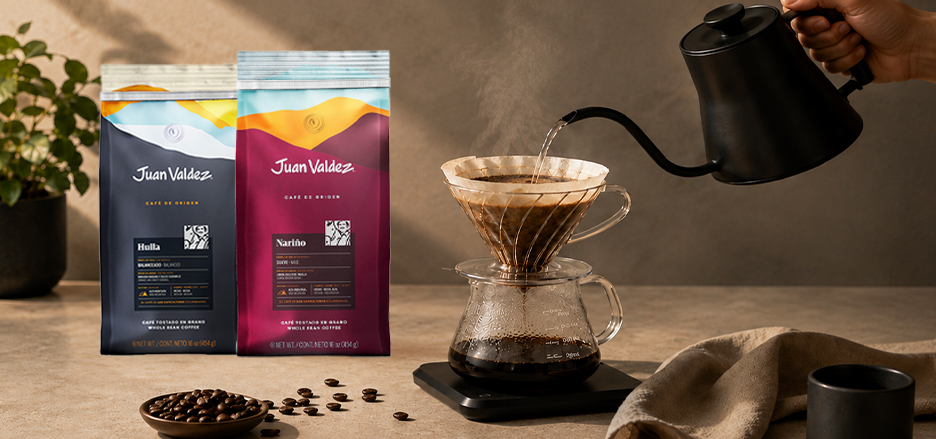
Juan Valdez Huila is an excellent choice for V60 brewing. Grown at high altitudes, these beans offer balanced acidity with notes of red fruit and chocolate. Thanks to the V60's clean extraction, each flavor becomes remarkably clear and well-defined in the cup.
For those looking for a brighter profile, Juan Valdez Nariño is a great option. Its lively acidity and citrus notes create a vibrant, refreshing cup that's perfect for starting the day. Both coffees showcase the unique character of Colombia's Andes Mountains, and the V60 is one of the best brewing methods for bringing those regional differences to life.
What Is the Ideal Grind Size and Coffee-to-Water Ratio?
A medium grind is ideal for V60 brewing—think of the texture of granulated sugar or coarse salt. It should be finer than a French press grind but much coarser than espresso. If the grind is too fine, the water flows too slowly, increasing brewing time and resulting in bitterness. If it's too coarse, the water passes through too quickly, leading to under-extraction and a weak, watery cup.
A great starting ratio is 15 grams of coffee to 225 ml of water, or 20 grams to 300 ml. This produces a balanced and approachable cup. If you prefer a stronger brew, try a 1:13 or 1:12 ratio. For a lighter, more delicate cup, experiment with 1:16 or 1:17. When you're just getting started, it's best to stick with the standard ratio before adjusting it to suit your taste.
Step-by-Step V60 Brewing Guide
Once everything is ready, begin by heating your water to 92–94°C (198–201°F). Boiling water can scorch the coffee, while water that's too cool won't extract enough flavor. If you don't have a thermometer, simply let freshly boiled water sit for about one minute.
Place the paper filter into the V60 and rinse it thoroughly with hot water. This removes any paper taste while preheating the dripper. Discard the rinse water from your server or mug. Add the ground coffee to the filter, gently level the coffee bed, then place everything on a scale and tare it.
Now it's time for the bloom. Pour about twice the weight of the coffee in water—for example, 30–40 ml for 15 grams of coffee. Make sure all the grounds are evenly saturated, then let the coffee bloom for 30–45 seconds. During this stage, the coffee releases carbon dioxide and expands. The more bubbles you see, the fresher the coffee beans are.
After blooming, begin the main pour. Slowly add the remaining water using gentle circular motions, moving from the center outward before returning to the center. Pour steadily without rushing, allowing the water to saturate the coffee evenly. The pouring phase should take 2 to 2½ minutes, with a total brew time of approximately 3 to 3½ minutes. Once the filter has completely drained, your coffee is ready to enjoy.
Tips for Better V60 Brewing
If you want consistent results, using a scale and a timer is one of the most effective habits you can develop. Estimating the amount of water by eye leads to different results every time.
Your pouring speed also matters. Pouring too quickly prevents proper extraction, while pouring too slowly can lead to over-extraction and bitterness. A slow, steady, and controlled stream is the key to a balanced cup, which is why a gooseneck kettle is so highly recommended for V60 brewing.
Be sure to keep the coffee bed evenly saturated. If the filter sticks to the sides and the outer grounds remain dry, the water may create channels and bypass part of the coffee, resulting in uneven extraction. Occasionally directing water toward the edges helps maintain an even brew.
Finally, don't overlook cleaning your V60 after every use. Residual coffee oils and grounds can affect the flavor of your next brew.
Brewing with Juan Valdez's single-origin coffees makes the V60 experience even more rewarding. Try Huila one week and Nariño the next using the same recipe, equipment, and brewing ratio. You'll discover two completely different cups, each expressing a unique side of Colombia's Andes Mountains.